


June 9, 2026
Back to Blog
Short Answer
After 18 years and thousands of wrapped work trucks at Canawrap in Metro Vancouver, the trucks that consistently generate phone calls share a common foundation: excellent design built on a strong brand visual identity, with the discipline to leave out everything that distracts from the one job a vehicle wrap actually does. That job is not immediate response advertising. It is top of mind awareness. And when design and brand are working together correctly, a wrapped work truck becomes the most cost-effective top-of-mind tool a home service contractor can own.
Design Is Everything, But Only the Right Kind of Design
Let me say something upfront, because this matters.
For a vehicle wrap, excellent and strategic design is non-negotiable. I’ve believed that since the first wrap came out of this shop almost 2 decades ago, and I still believe it today.
But excellent wrap design is a specific thing. It is not the most complex design. It is not the most detailed design. It is not the design that fits in the most information or showcases the most services or tells the most complete story about the business.
Excellent wrap design is disciplined design. It is brand identity-backed, visually strong, fully covered, and stripped of everything that is not required on that truck.
The difference between a wrap that generates calls and one that does not is almost never a lack of effort in the design. It is usually the presence of elements that are working against the design. Clutter, irrelevant messaging, information that belongs on a website or a brochure and not on the side of a van doing 80 kilometres an hour on the highway.
After years of watching wraps perform in real markets, I want to share what I know about why some of them work and most of them don’t.
The One Job a Vehicle Wrap Actually Has
Before we talk about what goes on a truck, it helps to be clear about what the truck is actually trying to do.
A vehicle wrap is not a Google ad. It does not ask for an immediate response. It is not trying to close a sale the first time someone sees it and it is not a gallery of before and after images.
A vehicle wrap is a top-of-mind awareness tool, a true mobile billboard. Its job is to put your brand in someone’s mind clearly and memorably, so that when they eventually need your service — next month, six months from now, a year from now — yours is the name that comes up first.
That is a different job than most advertising. And it requires a different approach to design.
If you understand that the wrap is building recognition over time, not generating a click right now, the design decisions that follow become much clearer. You are not designing for a single viewing. You are designing for the fiftieth time someone sees your truck in their neighbourhood and the brand has quietly settled into their memory as the one they know. I call this “priming a marketplace”.
That is how a wrapped work truck becomes a referral machine without the contractor ever asking for a referral. You have already baked your brand and your service into a prospective customer’s mind for when they require your service.
What Excellent Wrap Design Actually Looks Like
The wraps that do this job well share a consistent set of characteristics. These are patterns I’ve observed across thousands of installs, in every trade category, across every corner of Metro Vancouver.
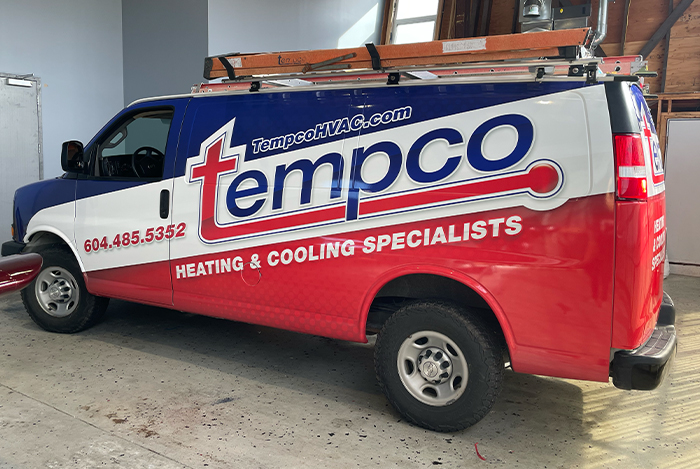
Full coverage. The strongest wraps use the entire vehicle. Not a partial, not a spot graphic, not a logo on the door. Full coverage commands attention and communicates commitment. In most cases, a partial wrap looks like a business that hasn’t fully committed to its own brand identity. Full coverage says something before the customer reads a single word.
A strong brand visual identity at the foundation. The design has to be built on something. That something is a clear, professionally developed brand identity. Cohesive colours, a logo that scales, typography that reads at speed. When the design is built on top of a strong brand foundation, every element on the truck is heading in the same direction. When it is built on a weak or undefined brand, the design has no anchor, and it shows, or worse, it looks like every other wrap on the streets.
One dominant visual message. The best wraps communicate one thing immediately. Not a list of services. Not a paragraph of text. One clear visual idea that registers in the two or three seconds a passing driver has to take it in. Everything else on the truck, contact information, secondary messaging, any supporting detail, exists to support that one dominant idea, not compete with it.
Ruthless removal of distraction. This is the design discipline that separates good wraps from great ones. Every element on a truck has to earn its place. If it is not, first and foremost, reinforcing the brand identity of the business and, secondly (and in its simplest form), the service provided, it does not belong on the truck. License numbers, long lists of certifications, multiple phone numbers, website addresses that nobody will ever type in while driving, these are the elements that quietly water down the impact of everything else on the truck or distract from the brand identity.
Readability at speed. A wrap is seen in motion (es i know that people see it parked, but the vast majority of people will see it while driving), in varied light, at distance. Type choices, colour contrast, and layout all need to be designed with that reality in mind. What looks sharp in a design file does not always translate to the side of a moving vehicle. This is something you can only learn by watching how real wraps perform in the real world, not by looking at mockups on a screen.
Why Brand Visual Identity Has to Come First
Here is where most contractors get the sequence wrong.
They call a wrap shop, they get a designer, and the design starts from scratch, or worse, it starts from a stock logo they bought online five years ago. The wrap gets designed around assets that were never built to work at the scale and visibility of a commercial vehicle. The result is a wrap that might look acceptable but is not doing the full job it could be doing.
Remember, this very specific medium has a specific job to do.
The strongest wraps I have ever put on the road were the ones where the brand visual identity was developed before anyone opened a design file. The logo built to work at multiple scales. The colour palette chosen with vehicle application in mind. The typography selected to perform at speed and distance.
When those elements are in place, the wrap design process is almost straightforward. The designer is not inventing a brand. They are applying one. And the result is a truck that looks like it belongs to a serious, established operation even when the business is newer than it looks.
That is the visual authority that a well branded, well designed truck carries with it and that authority is what creates the top of mind impression that eventually turns into a phone call.
The Test I Use Before Any Wrap Goes Into Production
Before a wrap goes into production at Canawrap, there is a set of questions I want answered.
Does the design communicate one clear, dominant message in under three seconds?
Does it look like the same brand as the website, the uniform, the business card, and the invoices?
Has everything been removed that is not earning its place on the truck?
Is the order of visual weight and importance correct? 1. Brand visual identity 2. The service offered 3. The basic contact info.
Does the design work in full sunlight, in rain, and at 50 metres?
If the answer to any of those is no, we are not done yet. Because a wrap that goes out without passing that test is doing a partial job. And a partial job on something that is going to represent the business every day for the next five to seven years is a cost that compounds over time in ways that are hard to measure but very real.
The Trucks That Build Businesses
The wraps I am most proud of are not always the most visually complex ones.
They are the ones where a contractor came back to the shop months later and told me something changed. Their market started recognizing them. Customers mentioned the truck, “I see you guys everywhere”. Neighbours started calling who had never been reached through any other channel.
That result is not an accident. It is what happens when excellent design, a strong brand visual identity, and a disciplined approach to what belongs on a vehicle all come together and do the job correctly.
The truck becomes a presence in the market. It builds familiarity in every neighbourhood it drives through. And familiarity, repeated over time, becomes the first name someone thinks of when the furnace stops working or the pipes back up or the roof starts leaking.
That is the return on a vehicle wrap done right. A business asset that is working every day, whether the contractor is on the job or not.
Ready to Talk About Your Truck?
If you are a home service contractor in Metro Vancouver thinking about a vehicle wrap, or looking at a current wrap that is not performing the way it should, we would like to start with the right conversation.
Not just colours and layouts. The brand behind the design, what the truck needs to communicate, and how to build something that does the job it is supposed to do for the next five to seven years.
Get in touch with the Canawrap team here, and we will start there.
Related reading:
- Canawrap Branding: Brand identity built specifically for home service contractors
- Vehicle Wrap FAQ: What to expect from the wrap process
- Financing: How to invest in your wrap without the upfront hit
About the Author
Jonathan Glen, Owner, Canawrap | Brand Strategy Consultant
Jonathan Glen has been in the vehicle wrap and visual branding industry for decades, operating Canawrap out of New Westminster, BC, a 3M Select certified wrap and branding shop serving home service businesses across Metro Vancouver. He also works with contractors and trades businesses across Canada and the US through his brand strategy practice.